
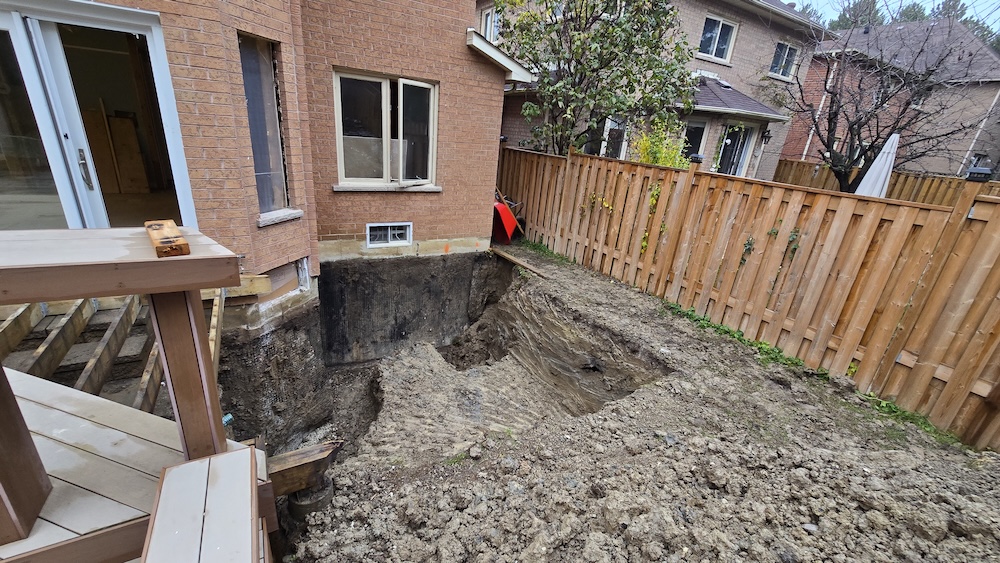
A pool deck renovation Toronto homeowners run before summer is the difference between a backyard you use in July and a backyard you keep meaning to fix. The pre-summer window is short — May through early June — but real: most refresh projects need 5–10 days on site and 2026 costs run $9,000–$32,000 depending on materials, coping work, and whether the deck stays the same footprint.
Key Takeaways
- 2026 pool deck renovation Toronto costs land between $9,000 for a concrete resurface and $32,000+ for a full porcelain or travertine rebuild with new coping.
- The pre-summer install window is genuinely 5–6 weeks long — booking before mid-May is the realistic deadline for a July-ready pool deck across the GTA.
- Coping and expansion joints fail first in 95% of GTA pool decks: the small details determine whether the deck lasts 8 years or 20.
- Toronto requires self-closing, self-latching gates and a 1.2 m enclosure for any in-ground pool — any deck change that touches the fence triggers a code review.
- Porcelain pavers have overtaken stamped concrete as the GTA premium choice in 2026: cooler underfoot, freeze-thaw stable, and 25–30 year life with proper installation.
Table of Contents
- The pre-summer window for pool deck renovation Toronto homeowners shouldn’t miss
- Concrete, travertine, porcelain, composite — pool deck materials for GTA homes
- 2026 pool deck renovation costs in the GTA
- Coping, expansion joints, and why the small details fail first
- Drainage, slip resistance, and Toronto pool safety code
- The pre-summer pool deck refresh: how a renovation lays out
- Why 905 Reno is the right team for pool deck renovation Toronto
- Frequently asked questions
The pre-summer window for pool deck renovation Toronto homeowners shouldn’t miss
If you own a pool in Oakville, Mississauga, Vaughan or North York, your renovation calendar isn’t really 12 months long — it’s about seven, and the high-value weeks are tight. A pool deck refresh needs the deck dry, the pool open (or openable), and overnight temperatures consistently above freezing for adhesives and sealants to cure properly. In GTA terms, that’s mid-April through mid-October, with a sweet spot in May and early June when the trades are still bookable, the ground is settled, and the project finishes in time for actual pool weather.
Wait until July and the project becomes a fall job — and a fall pool deck rebuild means you don’t enjoy your investment until next year. We see the same pattern every season: a wave of urgent calls in early July from homeowners in Etobicoke, Markham and Richmond Hill who realize the cracked stamped concrete they’d been “going to fix” is now the thing keeping the kids out of the water. By that point, the realistic install date is September.
The pre-summer push isn’t just about your usage window. It’s about supply. Coping stones, porcelain pavers, and travertine all ship from European suppliers — Italy, Turkey, Portugal — on lead times that grow from 4 weeks in March to 12+ weeks by August. Locking the order before the long weekend in May is what guarantees your materials are on site for the install date the contractor promised.
Concrete, travertine, porcelain, composite — pool deck materials for GTA homes
Choosing the deck surface is the single biggest decision in a pool deck renovation Toronto homeowners face. Each material has a personality and a maintenance burden:
Stamped or broom-finished concrete is still the entry-level GTA pool deck. Pour it in May, seal it in June, and you’ve added a usable surface for the lowest possible cost. The downside is freeze-thaw. The Canadian Concrete Pavement Association has documented that GTA concrete decks without proper expansion joints typically develop visible cracks by year 4 and structural cracks by year 8. A concrete refresh — saw-cut the cracks, fill, top-coat — buys 3–5 years; a full re-pour is often the smarter long-term call.
Travertine is the natural-stone classic, cool underfoot even in direct sun, and visually warm in a way that flatters most GTA backyards. Properly sealed and installed over a stable base, travertine lasts 25 years. The catch: travertine is porous, needs sealing every 2–3 years, and small chips along edges are part of the look you’re buying.
Porcelain pavers have become the dominant 2026 premium choice in our quotes for Vaughan, Markham, Aurora and Oakville pool projects. The 20 mm and 24 mm thick porcelain tiles are frost-proof, scratch-resistant, available in sizes up to 24×48 inches, and stay cooler in the sun than concrete or natural stone. Installation cost is higher because the base prep is more demanding, but the lifespan is the longest of the four mainstream options.
Composite decking with a concrete underdeck is the option homeowners forget about. For above-ground pools or raised decks, a composite surface gives a softer feel underfoot, a fast install timeline, and a fully removable system if the pool ever gets reconfigured. Composite is the right answer for pool houses with multi-level transitions where stone would create awkward step details.
2026 pool deck renovation costs in the GTA
Pool deck pricing in the GTA in 2026 reflects two stable years of material supply and a small premium on installation labour. The numbers below are typical installed ranges for a 600–900 sq ft deck — the most common size in GTA backyard pools.
| Project type | Material | Installed range (2026) | Expected lifespan |
|---|---|---|---|
| Refresh + reseal | Existing concrete | $3,500 – $6,800 | 3–5 years |
| Full re-pour | Stamped concrete | $9,000 – $15,500 | 8–12 years |
| Pavers over existing base | Travertine | $14,500 – $22,000 | 20–25 years |
| New deck with base prep | 20mm porcelain pavers | $19,000 – $32,000 | 25–30 years |
| Coping replacement only | Limestone or porcelain | $2,800 – $6,500 | 15–20 years |
Two factors push GTA pool deck renovation costs above the typical range: lifting and resetting coping when the original was installed too tight to the pool shell, and base remediation in older Mississauga and Etobicoke backyards built on clay fill that’s settled over 20 years. We almost always recommend a small structural contingency — 8–10% — for any rebuild older than 15 years.
If the pool deck rebuild is happening alongside a broader backyard refresh, our writeup on fire pits, pergolas, and outdoor lounges covers how to sequence multiple outdoor projects so the trades don’t trip over each other.
Coping, expansion joints, and why the small details fail first
If you walk a 15-year-old GTA pool deck, the surface usually looks okay from a distance. What fails first is the coping — the cap stones that sit on top of the pool wall and transition the deck to the water — and the expansion joints that separate the deck slabs from the coping and the pool shell. Once those joints lose their elasticity, water tracks behind the coping, freezes in November, and pries the cap stones loose by March.
Replacing coping at the same time as a deck refresh is one of those “pay now or pay double later” calls. A new porcelain deck installed against tired limestone coping looks beautiful for 18 months and then opens up a $4,000 problem. We’ve started recommending integrated coping + first-row paver details on every full deck rebuild for this exact reason.
Expansion joints — the soft, gasket-filled gaps between concrete slabs and around the pool — need to be at least 8 mm wide, filled with a polyurethane joint sealant (not silicone, not caulk), and replaced every 10 years. If your current deck has rigid grout in those joints instead of a flexible sealant, that’s the warning sign that the original installer cut a corner.
Drainage, slip resistance, and Toronto pool safety code
Two functional requirements shape every pool deck design in the GTA: water has to leave the deck quickly, and the surface has to be safe wet. A properly graded deck slopes 1/4 inch per foot away from the pool toward perimeter drains or the lawn beyond. Standing water on a porcelain deck stays standing — porcelain isn’t porous — so the slope and drain placement matter more on a porcelain deck than on a concrete one.
Slip resistance is rated by Coefficient of Friction (COF). A wet pool deck needs a COF of 0.6 or higher to be considered safe. Honed travertine, textured porcelain, and broom-finished concrete all hit the 0.6 mark; polished marble, glazed porcelain, and smooth-trowel concrete do not. If you’re shopping pavers at a showroom, the spec sheet should list the wet COF — if it doesn’t, that’s a flag.
Safety code is the third factor. Under the City of Toronto swimming pool fence and enclosure bylaw, every in-ground residential pool requires a 1.2 m enclosure with a self-closing, self-latching gate that opens outward from the pool. Any deck rebuild that touches the fence — including a new patio door cut into the pool fence wall — triggers a re-inspection. Most surrounding 905 municipalities have similar bylaws with slight wording differences, but the 1.2 m / self-closing / self-latching trio is consistent across Mississauga, Vaughan, Markham, Oakville, Burlington and Brampton.
The pre-summer pool deck refresh: how a renovation lays out day by day
A typical full pool deck rebuild for a 700 sq ft Vaughan or Oakville backyard runs about 9–12 working days from demo to final seal. Here’s the realistic shape of those weeks:
| Phase | Days | What’s happening on site |
|---|---|---|
| Demo + haul | 1–2 | Saw-cut existing deck, lift coping, dispose. Pool cover stays on. |
| Base prep | 2–3 | Grade, compact, geotextile, 4–6 inches of 19 mm crushed stone, screeded sand. |
| Coping install | 1 | Set coping first, level to the pool wall, mortar bed cure overnight. |
| Deck pavers | 2–4 | Set field pavers from coping outward, cut perimeter, polymeric sand or grout. |
| Joints + seal | 1–2 | Polyurethane expansion joints, surface seal, 24-hour cure before pool open. |
The hidden time-killer in every pool deck job is weather. A 1-day rain delay easily becomes a 2-day delay because the base needs to dry before the next layer. Booking early in the season builds that buffer in; booking late means a single bad week pushes you past the long weekend.
For homeowners thinking through the full pre-summer outdoor package, our ultimate guide to planning and designing your GTA renovation walks through how the pool deck slots into a larger landscape and interior project sequence.
Why 905 Reno is the right team for pool deck renovation Toronto homeowners trust

905 Reno is a full-service GTA renovation contractor, not a paver-only crew. That matters for a pool deck because the project is rarely “just” a deck: there’s usually a fence section to re-permit, a patio door to coordinate, an old shed to remove, and grading to integrate with the rest of the backyard. We’ve delivered pool deck projects across Toronto, North York, Etobicoke, Scarborough, Mississauga, Brampton, Vaughan, Markham, Richmond Hill, Aurora, Oakville, Burlington, Pickering, Ajax, Whitby, Oshawa and Bowmanville.
Our pool deck installs are sub-managed by the same project leads who run our kitchen and addition projects — which means consistent specs, real schedules, and a single point of accountability. The base prep is built to GTA freeze-thaw expectations, not warm-climate paver guidance imported from a U.S. distributor. We document every coping joint and expansion joint with photo records so warranty issues can be diagnosed without ripping pavers up.
And we sequence pool deck work against the rest of your reno calendar. If the deck refresh is the first step toward a custom home renovation next year, or an add-on to legal basement renovations you’re planning for the fall, we’ll plan the trades and the site access so nothing has to be done twice.
Lock in your pre-summer pool deck date. Call +1-416-995-4534 or request a free quote — we’ll measure your deck, walk you through material choices, confirm coping and code, and book you a 2026 install window that finishes before July.
Frequently asked questions
How long does a pool deck renovation Toronto project actually take?
A full rebuild is 9–12 working days on site for a typical 600–900 sq ft GTA pool deck. A refresh-and-reseal is 3–5 days. Add 4–8 weeks of lead time for material delivery, especially porcelain and travertine that ship from Europe.
What’s the best pool deck material for the Toronto climate?
20 mm or 24 mm porcelain pavers — frost-proof, scratch-resistant, cool underfoot, and a 25–30 year expected lifespan with proper base prep. Travertine is a close second for warmer aesthetic; concrete is the lowest cost but fails fastest in GTA freeze-thaw.
Do I need a permit for a pool deck renovation in Toronto?
A deck-only refresh on an existing in-ground pool typically doesn’t need a permit. You do need a permit if you’re changing the pool fence, increasing the deck footprint, building a raised deck more than 0.6 m above grade, or rebuilding the safety enclosure.
How much does it cost to replace pool coping in the GTA in 2026?
$2,800 to $6,500 for a typical 80-foot perimeter, depending on whether the existing field tile stays in place. Limestone and porcelain coping are the most common; precast concrete is the budget option.
When is the latest I can start a pool deck renovation and still finish before summer?
Mid-May is the practical deadline for a finish-before-the-long-weekend July project. After mid-June the math gets tight because of supply lead times, and after July 1 the realistic completion date slides into September.
Can a pool deck be done at the same time as other backyard renovations?
Yes — and bundling is usually cheaper. Combining a pool deck refresh with a fence rebuild, a patio door swap, a pergola, or new landscaping reduces mobilization costs and shortens the total disruption window. We sequence trades so nothing has to be redone.