
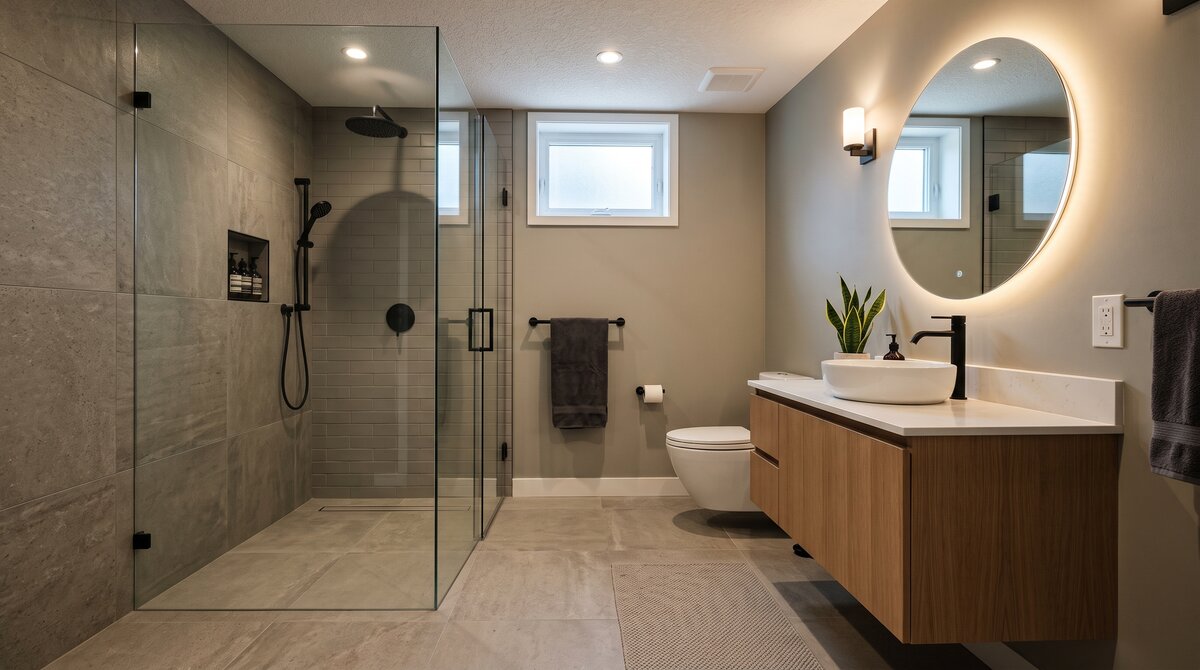
Basement Bathroom Addition in the GTA: 2026 Costs & Permits
Adding a bathroom below grade is one of the highest-value upgrades a GTA basement can get, and the short answer on price is this: a basement bathroom addition in Toronto and the 905 typically costs $18,000 to $35,000 in 2026 for a full three-piece bath, and $12,000 to $20,000 for a powder room. The number swings on one question most homeowners never think to ask — where does the waste go when the fixtures sit below the sewer line? This guide covers the real basement bathroom cost, the two ways to handle drainage, the Ontario Building Code rules that apply, and what a permit involves in Mississauga, Brampton, Vaughan, Markham and the rest of the GTA.
Table of Contents
Key Takeaways
- A basement bathroom addition in the GTA costs $18,000–$35,000 for a three-piece bath and $12,000–$20,000 for a powder room in 2026.
- Below-grade plumbing needs either a rough-in already under the slab, a new drain cut into the concrete, or a sewage ejector pump — the drainage choice moves the budget by $3,000–$8,000.
- Every basement bathroom needs a building permit in Ontario because it adds plumbing fixtures and, usually, new walls and electrical.
- The Ontario Building Code requires mechanical ventilation, a minimum ceiling height, GFCI-protected outlets and a backwater valve in most GTA municipalities.
- Most basement bathrooms take 2–4 weeks to build once the permit is issued, and they add real value to a legal second unit or a finished family basement.
Basement bathroom cost in the GTA (2026)
A basement bathroom addition in the GTA costs more per square foot than a main-floor bathroom because everything starts below the sewer line and often below the concrete. The table gives realistic 2026 installed pricing for Toronto and the 905, assuming a mid-range finish and a licensed, permitted job.
| Bathroom type | Existing rough-in | No rough-in (new drains) |
|---|---|---|
| Powder room (toilet + sink) | $9,000–$14,000 | $12,000–$20,000 |
| Three-piece (toilet, sink, shower) | $15,000–$24,000 | $18,000–$35,000 |
| Four-piece with tub and tile | $22,000–$32,000 | $28,000–$45,000 |
Roughly 35–45% of the budget is plumbing and concrete work, 20% is tile and waterproofing, and the rest is framing, electrical, ventilation, fixtures and finishing. If the basement is already being finished or converted into a second unit, the bathroom is cheaper as part of the larger job — see our legal basement renovation cost guide for how it fits into a full lower-level budget.
Drainage: break the slab or install an ejector pump?
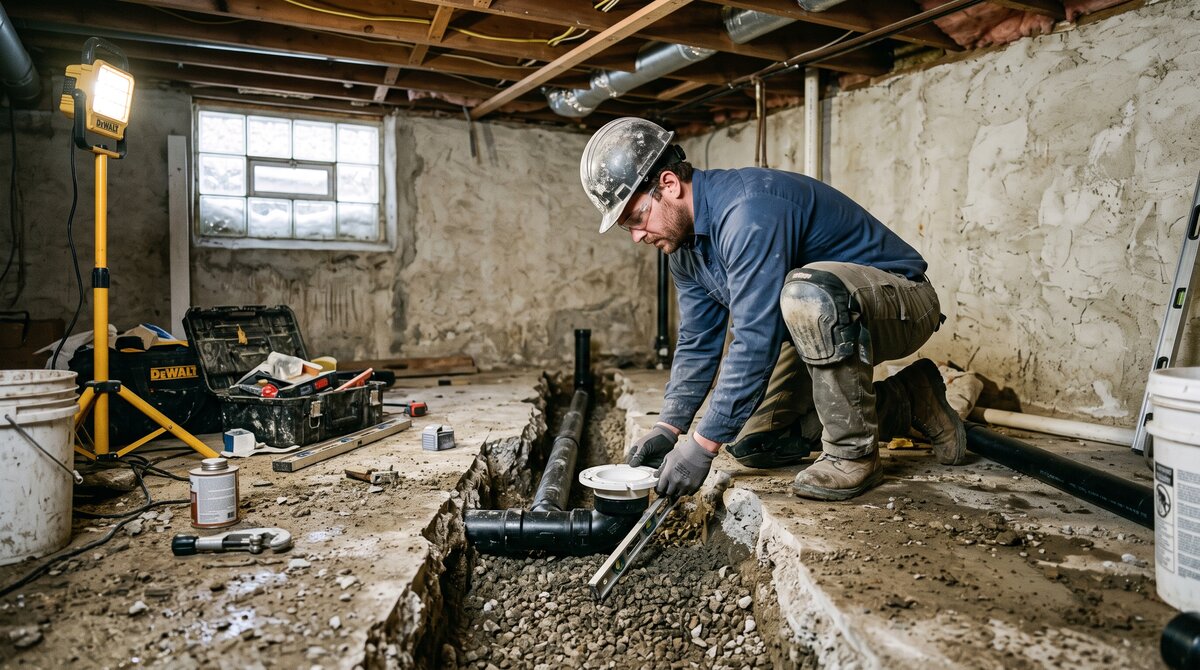
The single biggest cost driver in a basement bathroom addition is how the waste gets out. Basement fixtures sit at or below the level of the sewer lateral leaving the house, so gravity may not do the job on its own. There are three situations.
A rough-in already exists. Many GTA homes built after the 1990s have a capped toilet flange and drain stubs under the slab. Connecting to them is the cheapest path, typically $2,000–$4,000 of plumbing, and it is why a builder rough-in is worth checking for before you plan anything else.
Cut the slab and run new gravity drains. If the main drain is deep enough, a plumber saw-cuts the concrete, trenches to the stack, installs new ABS drains with proper slope, and re-pours. Expect $5,000–$9,000 for a three-piece. This is the preferred method when the depth works because there are no moving parts to fail.
Install a sewage ejector pump. When the fixtures sit below the lateral, waste collects in a sealed basin and a pump lifts it up to the main drain. A quality ejector system runs $3,500–$6,000 installed, needs a dedicated circuit and a vent, and will eventually need pump replacement (every 7–10 years). Upflush macerating toilets are a lower-cost alternative for a powder room but are louder and less durable for a family bathroom.
Not sure if your basement has a rough-in? 905 Reno will scan the slab, check your drain depth and price both drainage options in one visit. Call (416) 995-4534 or request a free quote.
Ontario Building Code rules for a basement bathroom
A basement bathroom must meet the same Part 9 rules as any other bathroom in the house, plus a few that matter more below grade. Since January 1, 2025, every permit application in Ontario is reviewed under the 2024 Ontario Building Code, which adopts the National Building Code with Ontario amendments. The rules your inspector will check include:
- Ventilation: a bathroom needs an exhaust fan ducted to the outside (not into the joist space), because basements already carry more moisture than upper floors.
- Ceiling height: finished basement rooms need adequate clear height; a bulkhead over a shower is a common failure point, so plan drops around the drains and ducts early.
- Electrical: outlets within reach of water must be GFCI-protected, and any new circuit is inspected by the Electrical Safety Authority separately from the building permit.
- Backwater valve: Toronto, Mississauga and most 905 municipalities require or strongly recommend a backwater valve when you add below-grade fixtures, to stop sewer backups from surfacing in your new shower. Several cities offer subsidies for installing one.
- Egress and smoke alarms: if the bathroom is part of a bedroom suite or a second unit, the egress-window and interconnected-alarm rules for that space apply at the same time.
If the bathroom is part of a legal second unit, the 2024 Code’s new “secondary suite” provisions — smoke-tight barriers, interconnected smoke and carbon-monoxide alarms and slightly relaxed door and stair heights — also apply. Our guide to legal basement apartments in Toronto walks through those requirements.
Permits in Toronto and the 905
Yes, you need a permit. Adding plumbing fixtures, building new partition walls and altering the concrete slab are all permit triggers under the Building Code Act. Working without one risks a stop-work order, a fine, and problems when you sell or insure the home.
In the City of Toronto, a basement bathroom is normally filed as a small residential project through the online building permit application, with a floor plan, a plumbing drawing and the fixture count. Mississauga, Brampton, Vaughan, Markham, Oakville and the Durham municipalities use similar online portals. Budget $300–$700 in permit fees for a standalone bathroom and 2–6 weeks for review, longer if the bathroom is bundled into a second-unit application. Your contractor should pull the permit and book the plumbing rough-in, framing, insulation and final inspections.
Timeline and what the work looks like
Once the permit is issued, a basement bathroom addition takes two to four weeks of on-site work. A typical sequence looks like this:
- Layout and slab work (days 1–3): mark the fixtures, saw-cut and trench the concrete or set the ejector basin, run drains and the water supply, then call the plumbing rough-in inspection.
- Re-pour and framing (days 4–6): pour the slab patch, frame the walls, add blocking for grab bars and the vanity, and run electrical and the exhaust duct.
- Inspections and drywall (days 7–10): framing and electrical inspections, then moisture-resistant drywall and a waterproofed shower base.
- Tile and fixtures (days 11–18): floor and wall tile, glass, vanity, toilet and fan, followed by the final plumbing and building inspections.
Heated floors are an easy add at the tile stage — see our heated bathroom floor cost guide — and they make a basement bathroom noticeably more comfortable in winter.
Is a basement bathroom worth it?
For most GTA homeowners, yes. A three-piece basement bathroom turns a rec room into a usable guest suite, makes a home office or gym self-contained, and is required if you ever want to rent the space as a legal unit. Real estate agents in Toronto and the 905 consistently list a finished basement with a full bathroom among the features buyers ask for, and a bathroom is the difference between a basement that counts as living space and one that does not.
The return is highest when the bathroom is planned with the rest of the basement: waterproofing first, then drainage, then layout. Adding a bathroom to an already-finished basement means opening finished floors and walls, which is why we recommend deciding on the bathroom before the flooring goes down. If moisture is a concern, read why basement waterproofing should come before any renovation.
Why 905 Reno is the right choice for a basement bathroom addition
905 Reno builds basement bathrooms as standalone projects and as part of legal basement renovations across Toronto and the 905 — Mississauga, Brampton, Vaughan, Markham, Richmond Hill, Oakville, Burlington, Pickering, Ajax and Whitby. Because our team handles the concrete cutting, licensed plumbing, electrical, tile and finishing under one permit and one schedule, the drainage is engineered correctly before a single wall goes up.
We price both drainage routes up front so you can choose between gravity drains and an ejector system with real numbers, and we build to the current Ontario Building Code with every inspection booked and passed. Whether you want a simple powder room or a full spa-style lower level, our bathroom renovation services and custom home renovation team deliver a fixed-scope quote, a written timeline and a workmanship guarantee.
Ready to add a bathroom to your basement? Book a free consultation with 905 Reno — call (416) 995-4534 or request a quote online and we will price your basement bathroom addition, permit included.
Conclusion
A basement bathroom addition in the GTA is a $12,000–$45,000 project in 2026 depending on the fixtures and, above all, the drainage. Check for a rough-in first, choose between cutting the slab and an ejector pump based on your drain depth, and plan for ventilation, GFCI outlets and a backwater valve from day one. With a permit in hand and a contractor who does the concrete and plumbing in-house, a below-grade bathroom is a straightforward build that pays back in daily comfort and resale value.
Frequently Asked Questions
How much does it cost to add a bathroom in a basement in Ontario?
In the GTA, a basement bathroom addition costs about $12,000–$20,000 for a powder room and $18,000–$35,000 for a three-piece bathroom in 2026. Homes with an existing under-slab rough-in sit at the low end; homes that need new drains or an ejector pump sit at the high end.
Do you need a permit for a basement bathroom in Ontario?
Yes. Adding plumbing fixtures, new walls or cutting the concrete slab requires a building permit under the Ontario Building Code, and any new wiring needs an Electrical Safety Authority inspection. Toronto, Mississauga, Brampton, Vaughan and Markham all accept the application online.
Can you put a bathroom in a basement without breaking concrete?
Yes, with a sewage ejector or macerating system that pumps waste up to the main drain. It avoids trenching but costs $3,500–$6,000, needs a dedicated electrical circuit and vent, and the pump will need replacing every 7–10 years. Gravity drains are preferred when the sewer line is deep enough.
How long does a basement bathroom addition take?
Plan on 2–6 weeks for the permit and 2–4 weeks of construction. Slab work and plumbing rough-in come first, followed by framing, electrical, inspections, drywall, tile and fixtures. Bundling the bathroom into a full basement finish adds time but lowers the cost per square foot.
Does a basement bathroom need a fan?
Yes. The Ontario Building Code requires bathroom ventilation, and an exhaust fan ducted to the exterior is the standard solution. Venting into the joist space or the furnace room is not permitted and leads to mould, which is a bigger risk in a below-grade room.
Does a basement bathroom add value to a home?
In the GTA, a finished basement with a full bathroom is one of the most requested features from buyers, and it is a requirement for renting the space as a legal second unit. Most homeowners recover a large share of the cost at resale and gain a far more usable lower level in the meantime.